Wall Padding for Gyms and Play Areas: A Buying Guide
Where gyms, play centers and trampoline parks need wall and column padding, how pads are built, which standards and fire rules apply, and how to order them right.

Short answer: Good wall padding for a gym or play area combines a foam core, a rigid backer and a commercial vinyl cover, fixed so pads sit tight with no gaps. Pad every wall, column and edge a running child can hit, ask for ASTM F2440 impact data, and confirm the fire rating your local code requires before ordering.
Wall padding is easy to underestimate. It looks like a finish, gets ordered late and is often measured in a hurry. Then the problems start: gaps between pads at the corners, columns wrapped only halfway up, covers that split at the bottom edge, or a fire inspector asking for a rating nobody requested.
This buying guide covers where gyms, play centers and trampoline parks need padding, how gym wall pads are built, which standards and fire rules apply, how to handle column padding and how to measure, order and maintain it. It pairs with our indoor playground flooring comparison, since walls and floors meet at the same impact points.
Key takeaways
- Pad any wall, column or edge inside or next to an active zone where a child can run, fall or bounce into it.
- ASTM F2440 covers impact attenuation of wall padding in indoor sports and recreational venues; ask suppliers which construction was tested.
- An insurer's loss-control guide advises Class A or B interior finish ratings for wall padding, with a one-class allowance in fully sprinklered buildings; confirm with your fire authority.
- Column padding should wrap the full exposed face to a height children can reach, with fastenings on the side away from traffic.
- Order padding with the layout drawing so openings, outlets and corners are designed in, not cut on site.
Where do gyms and play areas need wall padding?
You need wall padding wherever a moving person can reach a hard surface. That is the simplest rule and it covers most cases:
- Behind and beside play structures where a child can run or climb near a wall.
- Columns inside or at the edge of play zones, which are easy to collide with while looking elsewhere.
- Trampoline courts and foam pits, where walls and frames sit close to jumping areas.
- Ninja courses and climbing walls, at the ends of runs and around landing areas; see our ninja course equipment guide.
- Gym and multipurpose courts, at end walls and side walls close to boundary lines.
- Toddler rooms and party rooms, at low height where small children push carts and toys.
For courts, distance from the wall is part of the picture. EMC Insurance notes in a loss-control guide that a minimum clearance of three feet is required around the perimeter of a basketball court, with ten feet suggested, and that padding, while not required, is strongly advised for walls or fixtures that athletes may contact.
Collisions show up in playground injury data as well. In CPSC's review of reported playground incidents, collision patterns included collisions with other people, with equipment and with moving equipment.
What standards apply to wall padding?
The main standard is ASTM F2440, the specification for impact attenuation of wall padding used in indoor competitive and recreational sports venues. It covers wall padding and padding for other indoor structures across all padding constructions, and was written so buyers can tell whether a wall pad provides a minimum level of protection; the abstract lists shock absorption (g-max), HIC and thickness among the properties determined. Ask suppliers which construction was tested, by whom, and whether the pads you are buying match it.
Two other standards touch padding in play venues. ASTM F1918 for soft contained play covers materials, equipment and areas outside the equipment, so padding inside and around a play structure falls within its scope; Tumblewright designs soft play with reference to it. ASTM F2970 covers the design, installation, operation and maintenance of trampoline courts, including their surroundings; our trampoline park safety guide explains operator duties.
How gym wall pads are built
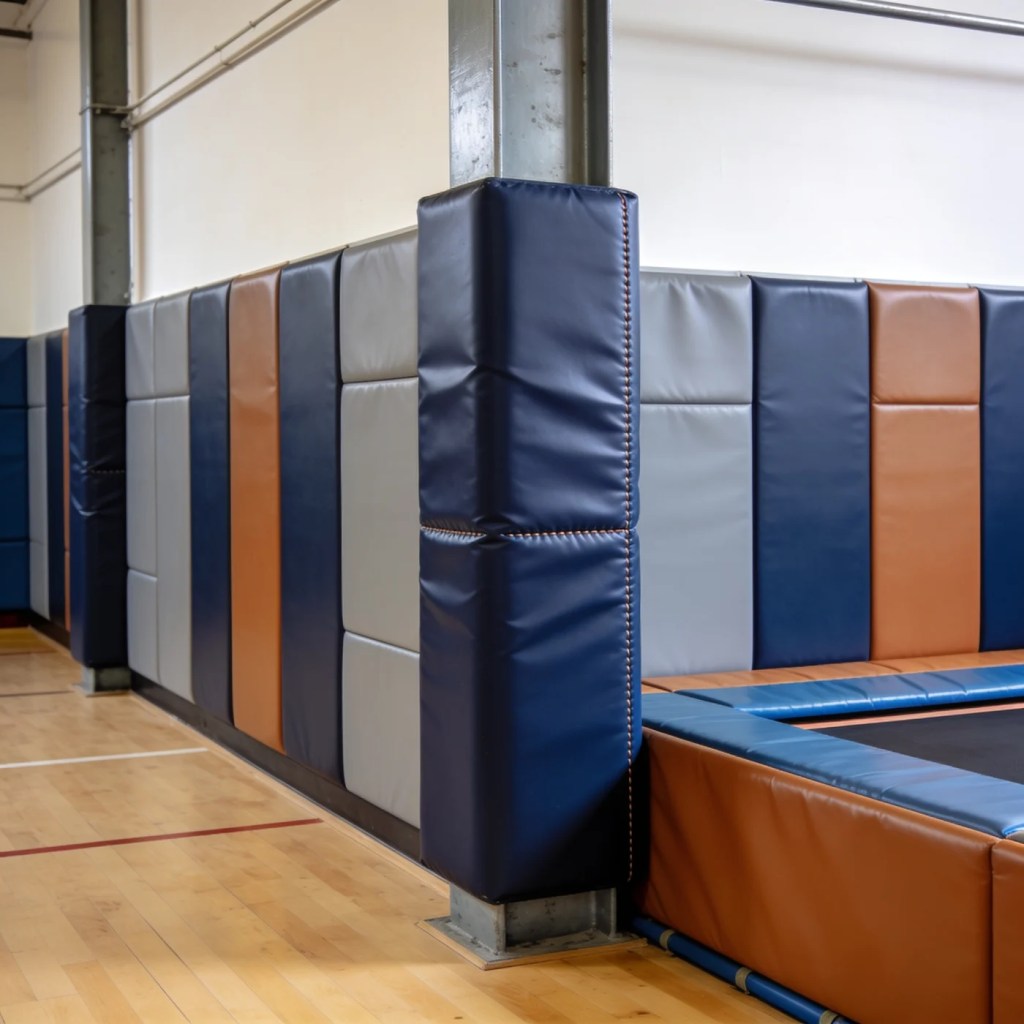
Gym wall pads have three layers: a foam core that absorbs impact, a rigid backer that holds the shape and takes the fixings, and a vinyl cover that resists wear and can be cleaned. Each layer has options, and each one changes performance and price.
| Component | Common options | What to ask the supplier |
|---|---|---|
| Foam core | Polyurethane or polyethylene foam in different densities and thicknesses | Density, thickness and the impact test data for that construction |
| Backer | Wood-based board or plastic panel; none for wrap-around column pads | Board type, moisture resistance, how it is bonded to the foam |
| Cover | Commercial PVC-coated vinyl in solid colors or printed graphics | Vinyl weight, abrasion and fire information, colorfastness |
| Fixing | Nailing margin, hanging clips or rails, hook-and-loop or zip for columns | Concealed or exposed fixings, removal for cleaning or repair |
| Edges and joints | Butt joints, overlapping flaps, corner pads, trim at the base | How gaps are closed at corners, ends and floor level |
| Cut-outs | Openings for outlets, switches, alarms, thermostats and signage | Whether cut-outs are made at the factory from your drawing |

Most of the cost sits in foam thickness and density, cover grade, the number of custom shapes and cut-outs, and printed graphics. A wall of identical rectangular pads costs less per square foot than a wall broken up by windows, outlets and corners.
Fire ratings: check before you order
Fire performance is the requirement most often missed. EMC Insurance's guide says padding should have an interior finish rating of Class A or B, and that in a building with a complete automatic sprinkler system Class C may be used where Class B is required and Class B where Class A is required. Interior finish ratings come from the flame spread test in ASTM E84.
Foam needs extra care. A code article published by the Minnesota licensing board for architects and engineers warns that foam can pass the E84 flame spread test yet still fail to meet code, because foam tends to melt away during that test, and that codes require large-scale tests such as NFPA 286, FM 4880, UL 1040 or UL 1715 for exposed foam plastic. The article cites the 2003 Station Nightclub fire, which killed 100 people after pyrotechnics ignited acoustic foam, as the reason for stricter rules.
Before you order, ask your local fire marshal or building official which rating and test reports they need for wall padding in your occupancy, and ask suppliers to confirm in writing what fire information they can provide for the exact cover and foam. Do not assume that a pad sold for a school gym meets the rule for your assembly occupancy.
Column padding: getting the details right
Column padding protects the hardest objects in most play areas, and it fails when it is too short, too loose or fastened on the wrong side. Specify it like this:
- Full wrap. Pad all exposed faces of a column in or near a play zone, not just the side facing the structure.
- Height. Run padding to the highest point a child or jumper can reach, including from platforms, trampolines or climbing features nearby.
- Fit. Make pads to the measured column size, square, rectangular or round, so they cannot rotate or slide down.
- Fasteners away from traffic. Put zips or hook-and-loop closures on the least exposed face and cover them with a flap.
- Base detail. Finish pads at a consistent small gap above the floor mat, or seat them on it, so mops and liquids do not wick into the foam.
Our wall and column padding is made to the column and wall dimensions on your layout drawing.
How to measure and order wall padding
Measure every wall and column on the drawing, not with a tape measure on opening week. A good padding schedule lists:
- Each wall length and the padded height required, from finished floor level.
- Every opening, outlet, switch, alarm, sprinkler head and door frame, with its position.
- Column sizes and shapes, with the height to pad.
- Inside and outside corners, and where pads meet the play structure or netting.
- Colors, logos or graphics, and the finish at the top edge.
- Wall construction behind the pads, which determines fixings.
Order spare pads or covers for high-wear spots such as entrances and slide exits, and keep the drawing so replacements match.
Installation, cleaning and inspection
Install pads so they sit tight to the wall and to each other; gaps at joints and corners are where fingers, heads and toys end up. After installation, add padding to your routine checks. The CDC facility guidance says to clean high-touch surfaces regularly, clean before disinfecting, keep disinfectants wet for the label contact time and never mix products; ask your supplier which cleaners are safe on the vinyl.
Check pads weekly for splits, loose fixings, compressed foam and open fasteners, and close the area or replace the pad if foam or a hard edge is exposed. Our indoor playground safety checklist includes padding in the weekly and monthly lists.
Tumblewright makes wall and column padding alongside our safety flooring and padding range and our kids ninja warrior courses, so walls, floors and equipment are drawn on one plan. Send us your floor plan and wall elevations for a padding layout and quote.
Frequently asked questions
How thick should gym wall padding be?
There is no single right thickness; it depends on the foam, the backer and how hard and fast people can hit the wall. Ask suppliers for impact test data for the exact construction to ASTM F2440, and choose thicker or denser padding near trampolines, ninja runs and court end lines.
How high should wall padding go in a play area?
Pad at least to the highest point a child can reach or fall against, including from nearby platforms, trampolines or climbing features. In open floor areas that is often a few feet; next to multi-level structures or trampoline courts it can be much higher.
Do wall pads need a fire rating?
Usually yes. Interior finish rules vary by occupancy and jurisdiction. An insurer loss-control guide recommends Class A or B ratings for wall padding, and foam may need large-scale fire tests. Ask your local fire marshal what is required before you order.
Can I pad columns with wall pads?
Use purpose-made column pads instead. Flat wall pads leave hard corners and gaps. Column pads are made to the measured column shape, wrap all exposed faces and close with fasteners placed away from traffic.
Sources
- ASTM F2440-24 Standard Specification for Impact Attenuation of Wall Padding Used in Indoor Competitive and Recreational Sports Venues, ASTM International, accessed October 2026.
- Basketball Court Clearance and Padding Rules, EMC Insurance Loss Control, accessed October 2026.
- Foam Plastic as Interior Finish (Code Official Corner), Minnesota Board of AELSLAGID, accessed October 2026.
- Injuries and Investigated Deaths Associated with Playground Equipment, 2001-2008, U.S. Consumer Product Safety Commission, accessed October 2026.
- ASTM F1918-21 Standard Safety Performance Specification for Soft Contained Play Equipment, ASTM International, accessed October 2026.
- ASTM F2970-25 Standard Practice for Design, Manufacture, Installation, Operation, Maintenance, Inspection and Major Modification of Trampoline Courts, ASTM International, accessed October 2026.
- When and How to Clean and Disinfect a Facility, U.S. Centers for Disease Control and Prevention, accessed October 2026.


