Buying Indoor Playground Equipment From China: Shipping, Duties and Lead Times
Lead times, ocean shipping, US duties and fees, customs filings and Canadian import steps for indoor playground equipment made in China, explained for buyers.

Short answer: Buying indoor playground equipment from China typically takes 10 to 14 weeks: 1 to 2 weeks for the layout and quote, 20 to 35 working days of production and about 4 to 6 weeks of ocean freight. Budget for freight, US duties, customs fees and broker charges, and confirm current tariff rates with a licensed customs broker.
Importing indoor playground equipment from China is routine work for freight forwarders and customs brokers. It is less routine for a first-time play center owner, and the surprises tend to be the same: a tariff change between quote and arrival, a missed filing that delays release, or a container that arrives before the site is ready.
This guide walks through lead times, how the equipment ships, the US duty picture as of October 2026, the fees and filings at the border, Canadian import steps and how to plan delivery and installation. If you are still shortlisting suppliers, start with our guide on how to choose an indoor playground equipment manufacturer.
Key takeaways
- Plan on about 10 to 14 weeks from first drawing to delivery at a typical pace, plus customs clearance and installation.
- US duty depends on the tariff classification of each item; a 2021 CBP ruling placed children's playhouses from China under HTS 9506.99.6080 at 4% plus a Section 301 duty.
- Tariffs on Chinese goods changed several times in 2026; get a written duty estimate from a licensed customs broker close to shipping.
- The Importer Security Filing is due at least 24 hours before the container is loaded in China.
- Canadian buyers register in CBSA's CARM system and should check whether any components fall under steel surtaxes.
How long does it take to buy playground equipment from China?
A custom indoor playground typically takes 10 to 14 weeks from first drawing to arrival, using Tumblewright's published typical figures: 1 to 2 weeks for the layout drawing and quote, 20 to 35 working days of production after you approve the drawing, and about 4 to 6 weeks of ocean freight to a US port. Production varies by product: soft play sets typically take 10 to 30 working days, trampoline parks 25 to 40 and EVA mats 10 to 20.
Three things stretch that timeline more than anything else: slow drawing approval, design changes after production starts, and peak-season shipping. Factory holidays matter too; many factories and logistics providers slow down or close around Chinese New Year, so orders that need to ship in the first quarter should be approved early. Build two to four weeks of buffer into any opening date, and do not book a grand opening until the container has cleared customs.
How is indoor playground equipment shipped?
Indoor playground equipment usually travels by sea in containers. Steel tubes, platforms and decks are bundled; foam and vinyl components are wrapped; slides, nets and small parts are cartoned and labeled against the packing list and drawing. Larger projects fill one or more full containers, while small play corners may share container space with other cargo through a consolidator.
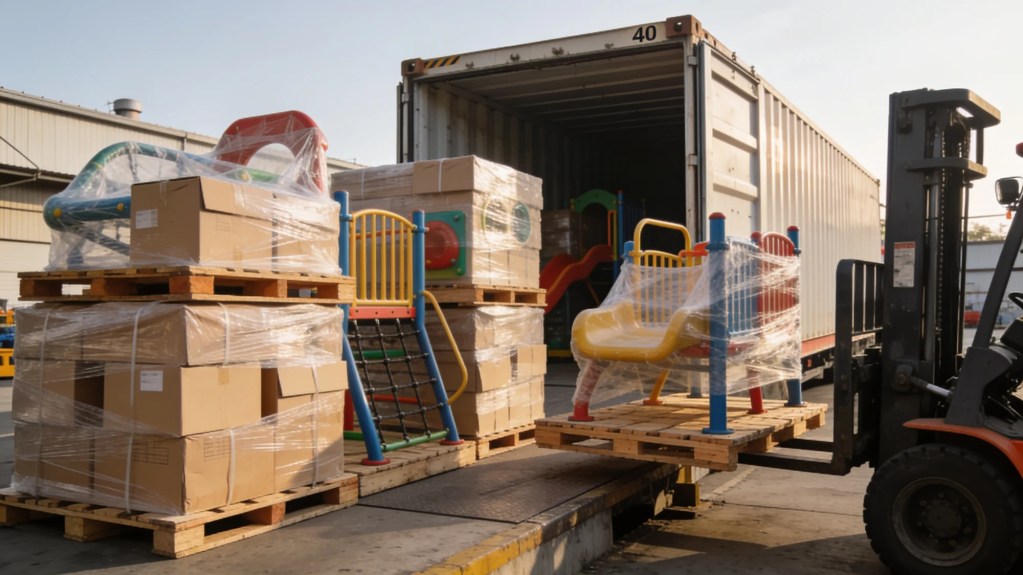
Agree the shipping term before you sign. The International Chamber of Commerce's Incoterms 2020 rules define which party pays for each leg and when risk passes from seller to buyer. Under terms such as FOB, you or your forwarder book the ocean freight from the named port of loading; under CIF, which the ICC reserves for maritime trade, the seller arranges freight and insurance to the destination port, and you handle import clearance and onward delivery. Whatever the term, confirm who arranges marine cargo insurance and at what value.
What import duties apply to playground equipment from China?
Duty starts with tariff classification, and classification depends on what each item is. In CBP ruling N320207 (2021), US Customs and Border Protection classified two children's playhouses from China under HTS 9506.99.6080, a heading for articles and equipment for exercise, sports and outdoor games, at a 4% base rate plus a 7.5% Section 301 duty under heading 9903.88.15. CBP rejected the toy heading because the items were principally used in playgrounds. The current USITC Harmonized Tariff Schedule still lists a 4% general rate for 9506.99.60.
A mixed order may not classify as a single item. Foam floor mats, furniture, projectors and electronics can fall under other headings with different rates. If you will import regularly, US regulations let you request a binding ruling for prospective imports by letter, with a full description, photos or drawings and, where possible, a sample, under 19 CFR Part 177.
The 2026 tariff picture for Chinese goods
Tariffs on Chinese-origin goods moved several times in 2026, which is why every estimate must be confirmed close to shipping:
- On February 20, 2026, the Supreme Court held that IEEPA does not authorize tariffs, and CBP stopped collecting IEEPA duties from February 24, 2026, according to DLA Piper's analysis. Existing Section 301 tariffs on Chinese goods and Section 232 tariffs were not affected. A temporary 10% Section 122 tariff followed for 150 days.
- From July 24, 2026, USTR imposed new Section 301 tariffs on about 60 economies after its forced labor investigations. China falls in the group facing an additional 12.5% duty, which may apply alongside existing Section 301 duties on Chinese goods, according to Greenberg Traurig. Annexes exclude some products, so check your tariff lines.
We cannot tell you your duty rate, and neither should any supplier. Send your broker the commercial invoice, packing list and drawings and ask for a written estimate; the chart below shows how the charges can add up for one illustrative classification.
What fees and filings are due at the US border?
Beyond duty, a commercial sea shipment carries several fees and filings. Most first-time importers hire a licensed customs broker to handle them.
| Item | What it is | Timing or amount |
|---|---|---|
| Importer Security Filing (ISF) | Shipment data filed with CBP for ocean cargo | At least 24 hours before loading at the foreign port; CBP may assess $5,000 per violation |
| Customs bond | Single-entry or continuous bond guaranteeing duties | Generally required before release |
| Entry filing | Formal entry of the goods | Within 15 calendar days of landing |
| Merchandise processing fee | CBP processing fee on formal entries | 0.3464% of value; $34.58 minimum and $670.86 maximum from October 1, 2026 |
| Harbor maintenance fee | Fee on cargo arriving by vessel | 0.125% of the cargo's commercial value |
| CPSC certificate eFiling | Certificate data for products that need a CPSC certificate | Filed at entry from July 8, 2026 |
The ISF timing comes from 19 CFR Part 149, and the $5,000 liquidated damages figure from GHY International. The 15-day entry rule and bond requirement are in 19 CFR Part 142. Fee figures come from Livingston International on the fiscal 2027 adjustment and Shapiro on the harbor maintenance fee. On product safety paperwork, a Foley and Lardner briefing explains that from July 8, 2026 importers must electronically file certificate data, including place and date of manufacture and the testing laboratory, for products that require a CPSC certificate. Ask your broker whether your items need one and make sure your manufacturer can supply the data.
Importing into Canada
Canadian buyers follow the Canada Border Services Agency's step-by-step import guide: confirm the goods can enter Canada, determine tariff classification and value for duty, register in the CBSA Assessment and Revenue Management (CARM) system, report the shipment, then declare the goods for release and pay duties and taxes. Since December 26, 2025, CBSA has applied a 25% surtax to certain steel derivative goods listed in a schedule, under Customs Notice 25-33. Playground structures include steel frames and fittings, so ask your broker to check every tariff item on your invoice against the current schedule. Depending on your location, routing through a Canadian port or through a US port with in-bond transit may make sense; your broker and forwarder can advise.
Planning delivery and installation
The container is not the finish line. Plan the last leg before the goods leave the factory:
- Site readiness. Floors should be level and clean, and ceiling heights confirmed against the drawing; typical clear heights are about 10 feet for a two-level structure and 14 to 17 feet for three levels.
- Unloading. Container deliveries need a dock or a forklift and crew; book them for the delivery window, because detention charges accrue if the container is held.
- Storage. If the site is not ready, arrange dry, secure storage near the port or the site.
- Installation. Confirm who installs, how long it takes for your footprint and what tools and access equipment are needed.
- Inspection. Check cartons against the packing list on arrival and photograph any damage before signing the delivery receipt.

For a view of the whole budget, including freight and duties, see our indoor playground cost breakdown and the step-by-step guide on how to start an indoor playground business. Weighing a used structure instead? Our new vs used soft play comparison covers the tradeoffs. Browse our indoor playground structures, safety flooring and padding and EVA interlocking foam mats, then send your floor plan and we will draw a layout and quote with a shipping plan.
Frequently asked questions
What is the import duty on playground equipment from China?
It depends on how each item is classified and on the tariff actions in force when it enters. A 2021 CBP ruling placed children's playhouses from China under HTS 9506.99.6080 at 4% plus a 7.5% Section 301 duty, and a further 12.5% Section 301 duty on Chinese goods took effect on July 24, 2026. Ask a licensed customs broker for a written estimate for your specific items.
Do I need a customs broker to import a playground?
It is not legally required in every case, but most commercial importers use one. A broker files the entry, arranges the bond, often files the ISF and checks classification and any CPSC certificate data. For a first import, the broker's fee is often small compared with the cost of a delayed or incorrect entry.
How long does shipping from China to the US take?
Tumblewright's typical figure for ocean freight to a US port is about 4 to 6 weeks. Add time for customs clearance, inland trucking and unloading. Peak seasons, port congestion and factory holidays can extend it, so build in buffer before your opening date.
What is an ISF and who files it?
The Importer Security Filing is advance shipment data that US regulations require for ocean cargo, generally no later than 24 hours before the goods are loaded at the foreign port. The ISF importer, usually the buyer or its customs broker, is responsible, and late or inaccurate filings can lead to liquidated damages.
Can I avoid tariffs by shipping through another country?
No. Duty depends on the country of origin, which is where the goods were made, not the route they take. Misstating origin is a customs violation. If tariffs change your budget, discuss scope, phasing or classification questions with your broker instead.
Sources
- Harmonized Tariff Schedule search: 9506.99.60, US International Trade Commission, accessed October 2026.
- CBP ruling N320207: classification of children's playhouses from China (2021), US Customs and Border Protection, via open-gov ruling archive, accessed October 2026.
- USTR Imposes New Section 301 Forced Labor Tariffs on Imports From 60 Economies, Greenberg Traurig, July 2026, accessed October 2026.
- US Supreme Court holds IEEPA does not authorize tariffs, DLA Piper, February 2026, accessed October 2026.
- 19 CFR Part 149: Importer Security Filing, Electronic Code of Federal Regulations, accessed October 2026.
- 19 CFR Part 142: Entry Process, Electronic Code of Federal Regulations, accessed October 2026.
- 19 CFR Part 177: Administrative Rulings, Electronic Code of Federal Regulations, accessed October 2026.
- CBP to increase user fees for fiscal year 2027, effective October 1, 2026, Livingston International, accessed October 2026.
- Harbor Maintenance Fee (HMF), Shapiro, accessed October 2026.
- US Importer Security Filing (ISF): Requirements, Deadlines, and Penalties, GHY International, accessed October 2026.
- CPSC eFiling Begins July 2026: Importers of Consumer Products, Are You Ready?, Foley and Lardner LLP, 2026, accessed October 2026.
- Step-by-step guide to importing commercial goods into Canada, Canada Border Services Agency, accessed October 2026.
- Customs Notice 25-33: Steel Derivative Goods Surtax Order, Canada Border Services Agency, accessed October 2026.
- Incoterms 2020, International Chamber of Commerce, accessed October 2026.


